ELEMENTS
The elements of design are the pieces, the components, the building blocks of design.
Elements are like the ingredients in a recipe, the parts of a car or the notes in music. On their own, these elements may do little, but put together skillfully, they create a cake, a Corvette or a concerto.
The elements of design include line, shape, color, value and texture. Put together skillfully, they create effective visual communication.
LINE
A line is:
- A mark that has length, but little width
- A large number of connected points
- A moving point
A line can have different qualities – it can be curved or straight, thin or thick, loose or precise, delicate or bold, expressive or controlled. These qualities create different feelings: a curved line feels natural and organic, while a straight line feels manmade and mechanical. A delicate line feels soft and feminine, while a bold line feels strong and masculine.
A horizontal line reminds us of a calm horizon or a person lying down; it evokes feelings of quiet and rest. A vertical line makes us think of a skyscraper or a person standing straight and tall; it feels strong and aspiring. Since a vertical line contains potential for activity, it creates a more energetic feeling than a horizontal line. A diagonal line is like a bolt of lightning or a person leaning forward poised to run; it conveys energy and movement. Diagonal lines are the most dynamic type of line.
Not all lines are actual lines; sometimes we perceive lines that are not really there. Implied lines are created by a series of points, such as a dotted line or a group of objects lined up in a row. Psychic lines are not real lines at all, but instead are lines we sense or feel; for example when a figure’s eyes are looking in a specific direction or when a line or shape is pointing at something.
SHAPE
A shape is:
- An area defined by a boundary
- An area created by color, value or texture
- An area created by surrounding shapes
A shape is a two-dimensional object; it has height and width but no depth. A mass or volume is a three-dimensional shape (or is perceived as such); it has height, width and at least the appearance of depth.
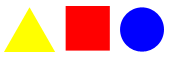
 Geometric shapes, such as circles, squares, triangles and rectangles, are based on mathematics and have straight edges and regular curves. Straight edges and angled lines create rectilinear shapes. Curves and rounded forms create curvilinear shapes.
 Natural, or organic, shapes are found in nature, for example rose flowers, tree branches or bamboo leaves.
 Abstract, or stylized, shapes are natural shapes that have been altered or simplified to reflect the essence, rather than the actual representation, of an object.
 Nonobjective, or nonrepresentational, shapes are not derived from any specific element or elements; they represent nothing other than the pure shapes we see.
COLOR
Color is:
- A property of light
- Visible when light is emitted or reflected
- Determined by the wavelength of light
 Additive color is created from emitted light, such from a video screen, a computer monitor or theatrical lights. The additive primary colors are red, green and blue and all other additive colors are derived from them. Combining two primary colors yields a secondary color: magenta (red and blue), cyan (blue and green) and yellow (red and green). Combining all three additive primaries results in white; for example, shining red, green and blue stage lights all in the same area creates a white spotlight. The absence of all additive primaries (in other words, no light) results in black (as in a dark room).
 Subtractive color is what we see when light reflects off a surface, such as ink on paper or paint on a wall. The subtractive primaries are red, yellow and blue; combined they form the subtractive secondaries orange (red and yellow), green (yellow and blue) and purple (blue and red). Combining all three subtractive primaries theoretically results in black (although impurities in pigments usually prevent us from creating a true black this way). The absence of all subtractive primaries (in other words, no pigment) results in white (think of a blank canvas).
The three properties of color are hue, value and saturation.
 Hue refers to the pure state of a color; it is the name we give a color, such as red or blue.
 Value refers to the lightness or darkness of a color. Adding white to a hue creates a lighter value (a tint); for example, adding white to red creates pink. Adding black to a hue creates a darker value (a shade); adding black to red creates maroon.
 Saturation, also known as intensity or chroma, refers to the how bright or dull a color is. Highly saturated colors are close to the pure hue of a color; they are bright and vivid such as pure red or pure yellow. Mixing pure colors with either gray or the color’s complement (the opposite color on the color wheel) will desaturate or mute the colors. Colors with very low saturation are considered neutrals (gray, beige, ivory, taupe).
Temperature refers to how warm or cool a color feels to us. The warm colors red, orange and yellow remind us of fire and sunlight; they create a sense of warmth in an image. The cool colors blue and green make us think of water and plants; they create a feeling of coolness in image. Warm colors tend to feel brighter and more energetic, while cool colors seem calmer and more relaxed.
 Color schemes, or color harmonies, are groups of colors that work well together. The color wheel, which is a visual representation of the subtractive primary, secondary and tertiary colors, forms the basis for color schemes.
 A monochromatic color scheme involves variations in value of a single hue. Monochromatic schemes are very well-unified, but lack variety.
 An analogous color scheme uses adjacent colors on the color wheel, as well as their tints and shades. Analogous color schemes are well-unified, but have more variety than monochromatic scheme.
 A complementary color scheme uses colors that are opposite each other on the color wheel (known as complements). When complements are mixed together (mixing yellow and purple paint, for example), they desaturate or neutralize each other, but when they are placed next to each other they intensify and energize each other.
 A split complementary color scheme uses the two colors adjacent to the color’s complement for balance. A split complementary scheme offers more variety than a complementary scheme.
 A triadic color scheme is created using three colors equally spaced on the color wheel; red, yellow and blue form the primary triad and orange, green and purple form the secondary triad. Triadic colors schemes are lively and can be used to create dynamic designs.
VALUE
Value is:
- Lightness or darkness
- Always relative to other values
- How we perceive form
 Value contrast refers to the degree of variation between light and dark . The narrower the range of values, the lower the value contrast. The highest value contrast is obtained using solely black and white.
When the the values are predominantly light, an image is referred to as high key; when they are mostly dark, an image is considered low key.
Value adds volume to a shape; gradual shading on a circle will make it look like a sphere. Value creates the illusion of space (atmospheric perspective); areas with high value contrast seem closer while areas with low value contrast recede into the distance. Value adds emphasis; areas of high contrast will stand out in areas of low contrast.
Value can evoke feelings or moods. Low value contrast creates a subtle, restrained effect that feels calm and still. High value contrast creates excitement and drama. The light values of high key images convey the sense of happiness and lightness, mid-range values evoke sadness and depression, and the dark values of low key images create feelings of fear and mystery.
Value is important in creating balance; darker values are visually heavier than lighter values (so a small dark element can balance a larger light one).
TEXTURE
Texture is:
- The quality of a surface
- Roughness or smoothness
- The sensation of a tactile surface
Actual, or tactile, texture is texture we can actually feel by touching a surface. In visual design, actual texture is in the feel of the canvas or the surface of the paper. Actual texture can be created by the thickness of the paint or through collage.
Visual, or simulated, texture can’t actually be felt by touch. It is texture we see rather than feel, but we perceive it tactilely.
Visual textures can be created by copying the value patterns of actual textures; the darks and lights are used to suggest the three-dimensional roughness of a surface. Visual texture can also be created by repeating marks or shapes. Letters and words (text) on a page create a visual texture and changing the size and spacing of the text changes the look and feel of the texture.